Every connected system is already inside a social situation.
Design can decide what it does there.
I came to design from sociology, and from poetry.
Together they produce a specific quality of attention.
Sociology finds what is operating in a situation beneath what is visible.
Poetry finds the image that makes it available to be felt.
Design makes it concrete enough to build toward.
They are the same inquiry, conducted in different registers. They converge through all my work. One instrument for designing the emotional and relational situations that a product or system can invite in a human life.
Situation-centric design practice
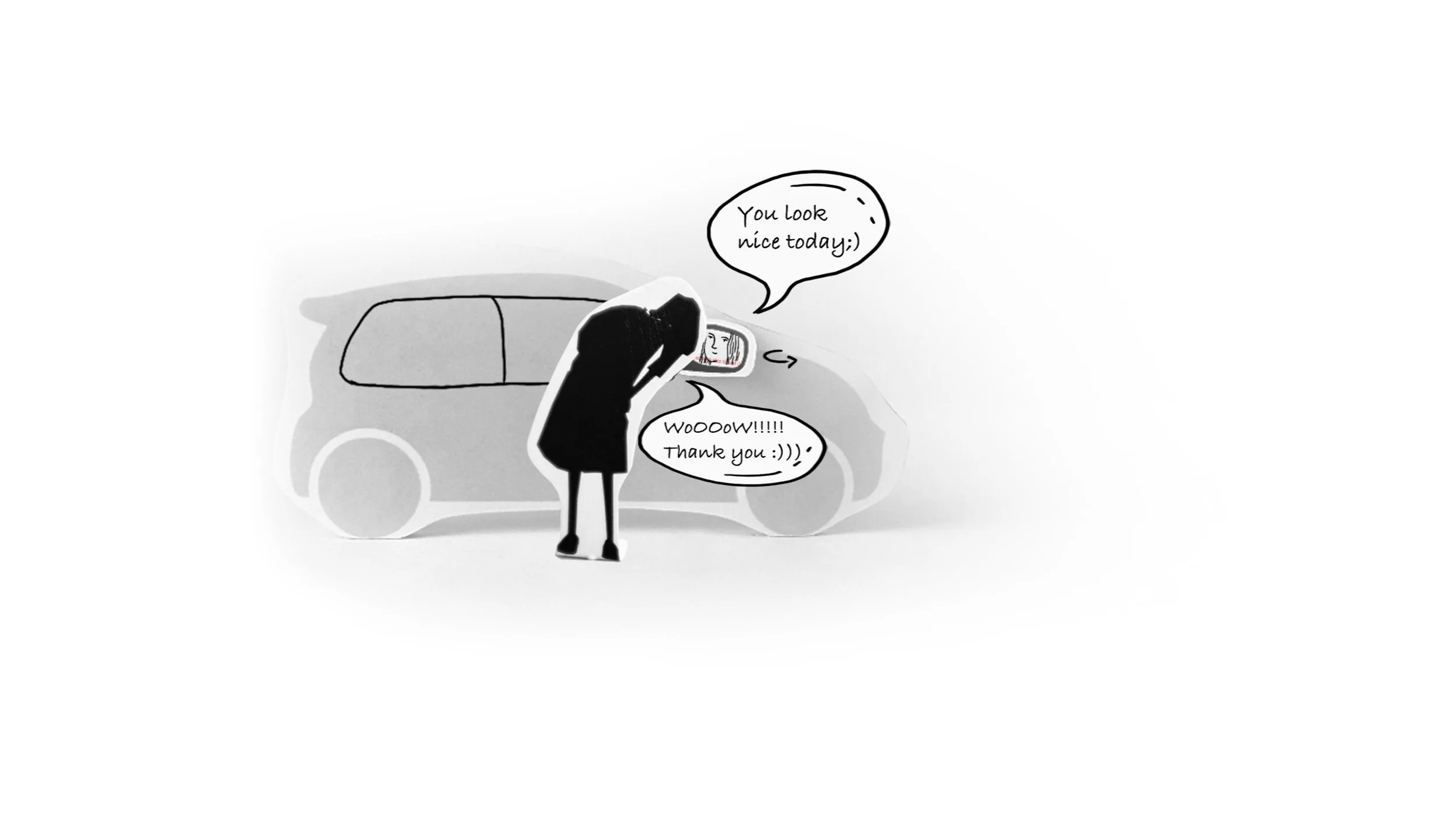
A car’s side mirror rests facing inward, toward an absent driver. The street outside, the people walking past, the life happening around it: not its concern. The car was designed for one relationship. The situation it sits inside contains many others.
This is where I start.
The gap between what a connected system currently does and what the situation it inhabits actually contains. I call this the surplus of social possibility. It is always there. Design finds it.
A parked vehicle whose side mirror turns outward produces a different social presence: the vehicle is no longer facing entirely away from the life around it. That is the whole gesture, and it is enough to shift what kind of object it feels like — closed and private, or quietly attentive to the street it sits on.
Experience design’s existing vocabulary was built for a narrower relationship with technology than the one we are now living inside.
The task shrinks. The situation expands.
As adaptive AI systems become more capable of handling the task itself, design attention does not disappear. It moves toward what was always in the situation and never had anywhere to go: the emotions, the relations, the intentions sitting just outside the frame the task drew around itself.
The situation-centric paradigm takes the situation as the design space. Not the task. Not the user in isolation. The full social moment the system is already inside.
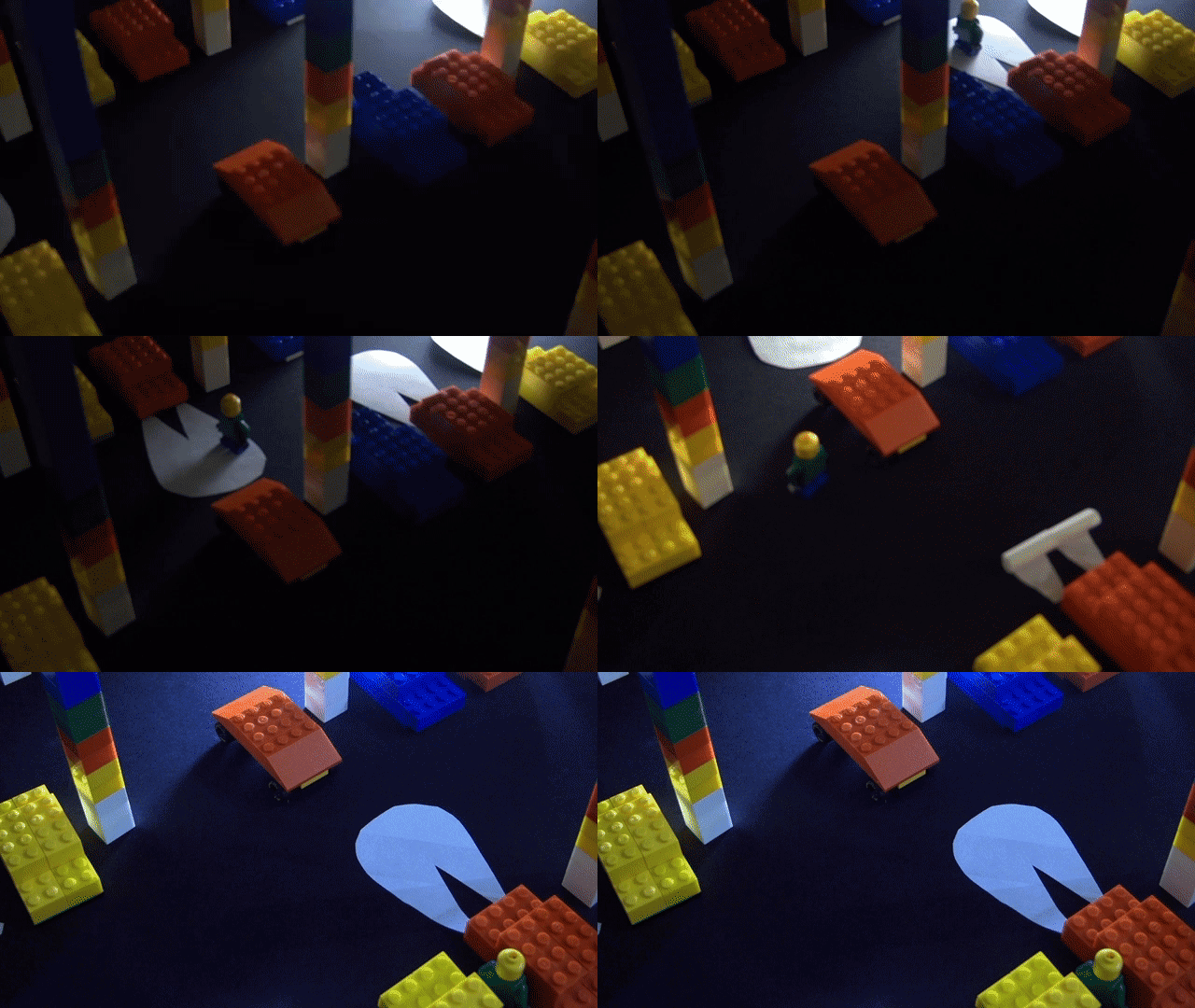
The lights came on softly for a stranger walking through a dark parking structure at night. Not for the owner, who was elsewhere. Triggered by presence, not ownership. The system simply attended to the situation it was in.
A car with a bicycle bell instead of a horn, because a horn carries the grammar of a private vehicle asserting priority: “Move. Out of my way.” When a car approaches a cyclist, the situation requires something closer to: “I see you. Take your time.”
These are not features. They are the form a design proposition takes when the situation is the starting point.
The situation contains more than the task. A system present to its full social context, rather than only waiting for the next command, becomes a different kind of participant in the life around it.
Participant. Not tool. Not assistant. The word carries a different design obligation.
This is the design space I work in.